The science

What happens across the air gap

A technical account of how the device works: the capacitive circuit that closes through air, the three phenomena the handpiece delivers, and the parameters that set dose from a dog to a horse.

01

The circuit

Every established radiofrequency device in veterinary medicine is monopolar. That single word explains almost every compromise the category asks you to make.

Energy has to complete a loop through the patient, from an electrode at the treatment site to a return plate elsewhere on the body. Both ends need bare, creamed skin held under firm pressure. That is where the clipping, the cream and the restraint all come from.

BYONDA does not complete its loop through the animal. It completes it capacitively, across the air gap between the emitter and the tissue.

The emitter and the tissue behave as the two plates of a capacitor, with air and coat simply part of the gap between them. Energy is deposited inside the tissue itself, so nothing needs clipping, creaming or pressing.

MONOPOLAR Current loops through the patient Generator Tissue Electrode Return plate CAPACITIVE, CONTACTLESS Field couples across the gap Generator Emitter plate Air gap Tissue
Monopolar: a galvanic loop closed through the animal, with two contact points, both clipped and creamed. Contactless: displacement current across a dielectric gap, heat generated internally. No contact, nothing clipped, no consumables. The therapeutic effect is comparable; the demands on the patient are not.
02

Three phenomena, one gesture

The handpiece does three things simultaneously, at different depths, and the combination is what the protocol is built around. We call it sonodiathermy.

PHENOMENON 01

Deep radiofrequency

An electromagnetic field alternating at approximately 0.470 MHz drives charged particles and polar molecules within the tissue back and forth. The resulting molecular friction raises temperature inside the tissue rather than on its surface, which is the defining property of diathermy. Because the field is capacitive, the coat and air gap simply sit in the dielectric path rather than blocking it.

Frequency
≈ 0.470 MHz
Max output
300 W
Load impedance
1 kΩ
Emitter air gap skin surface peak deposition
PHENOMENON 02

Therapeutic sonic waves

A pulsed mechanical stimulus travels with the field. Where the RF component acts thermally, this one acts mechanically: tissue is cyclically compressed and released, so cells contract and expand in a continuous rhythm.

The intent is regenerative rather than thermal, supporting cell turnover and helping move inflammatory load out of the area at intensities well below anything of thermal concern.

pulsed stimulus Contraction Expansion
PHENOMENON 03

Ionic ozone

The field ionises a small quantity of ambient oxygen at the emitter face, producing ozone that acts at the surface, purifying and revitalising skin and coat while the RF and sonic components work beneath it.

Emitter face O₃ formed in the gap skin surface RF works below this line
03

Depth and dose

Adaptive frequency is how one handpiece serves a 4 kg dog and a 600 kg horse.

Tissue changes during a session as it warms and perfusion increases. The generator tracks that load and adapts, keeping energy arriving at the intended layer instead of the surface.

Depth is set by the operator through power, frequency and cycle settings, not by swapping hardware.

EMITTER Air gap Epidermis Dermis Hypodermis
Energy density falls with depth. The operator sets which layer receives the peak.

Epidermis

Surface activation

Passed through, not targeted. The ozone effect acts here at the surface.

Dermis

Collagen & circulation

Circulation increases and collagen production is stimulated.

Hypodermis and below

Metabolic activation

The target for osteoarticular work, at depths no manual therapy reaches.

A dog is not a horse

Mass, coat and target depth all change the correct dose. Dosimetry tables ship with the device, and session parameters are recorded so protocols stay reproducible across your team.

04

Why there are no hot spots

Burn risk in contact diathermy is a current-density problem, not a power problem.

Wherever an electrode touches skin imperfectly, current crowds into the few points that do make contact and heat builds exactly there. The standard fix is to turn the intensity down, which protects the patient by under-treating them.

With no contact there is nothing for current to crowd into. The field arrives spread evenly across the emitter, so the mechanism that creates hot spots never exists in the first place.

Contact: current crowds energy concentrates at the high points Contactless: field distributes even deposition, no crowding geometry
Hot spots are created by contact, not by radiofrequency. Remove the contact and the mechanism goes with it.
05

Specifications

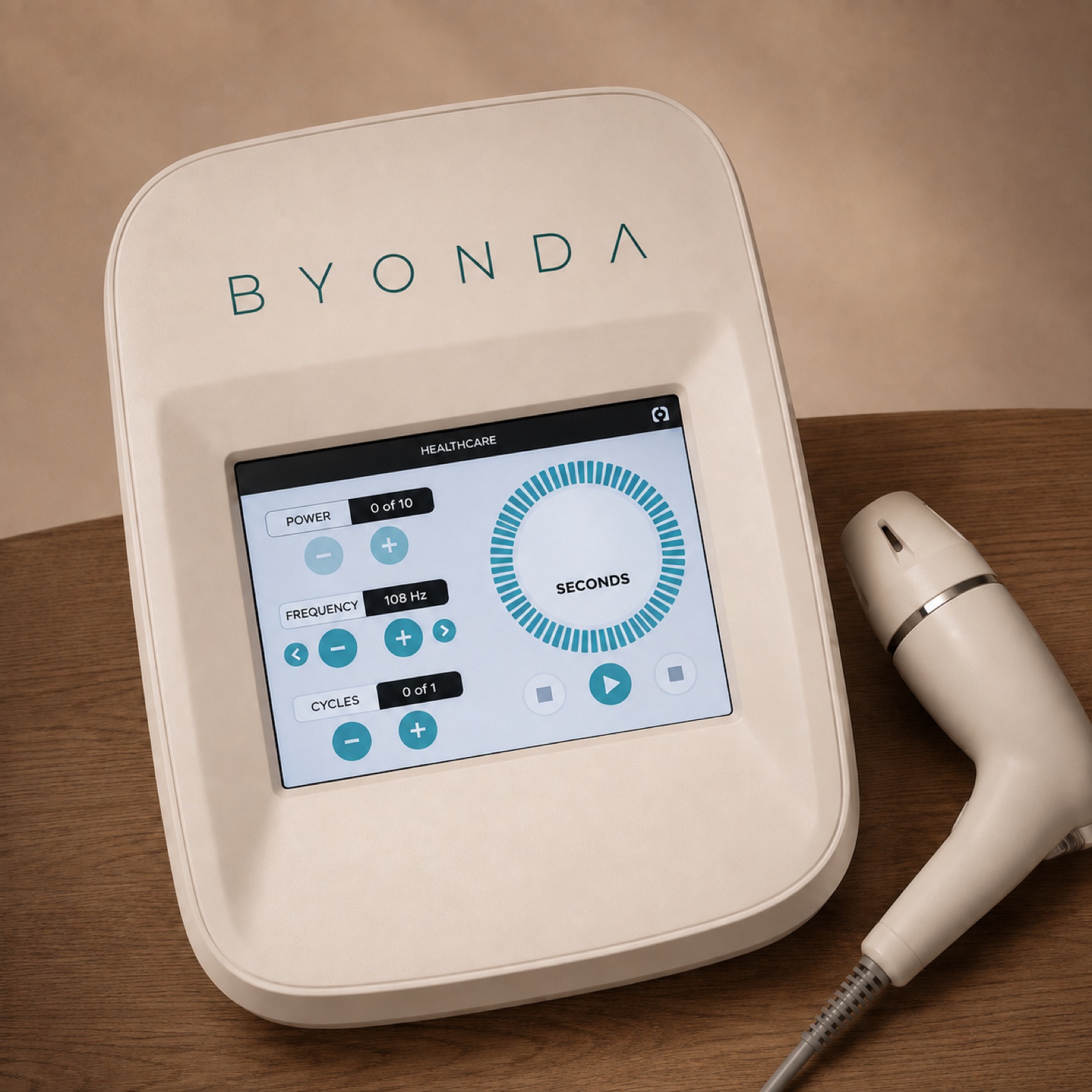
The BYONDA base unit with touchscreen controls and the detachable handpiece

Electrical

Power supply
110–240 VAC, 50–60 Hz
Consumption
50 VA
RF output
300 W
Output frequency
≈ 0.470 MHz
Load impedance
1 kΩ
Insulation class
I

Build & format

Dimensions (W×H×D)
40 × 310 × 230 mm
Weight
10 kg, handpiece and base
Handpiece
Detachable
Connectivity
Industry 4.0 compatible

Control

Programmes
Pre-loaded, editable
Adjustable
Intensity, frequency, treatment cycle
Calibration
Manual calibration supported
Operating range
10–40 °C · 30–75 % RH · 700–1060 hPa
Storage range
−40 to 75 °C · 30–75 % RH · 700–1060 hPa

Open demo

You have read the science, now watch it work

We bring the device to your practice and treat real patients alongside your team.

Request an open demo